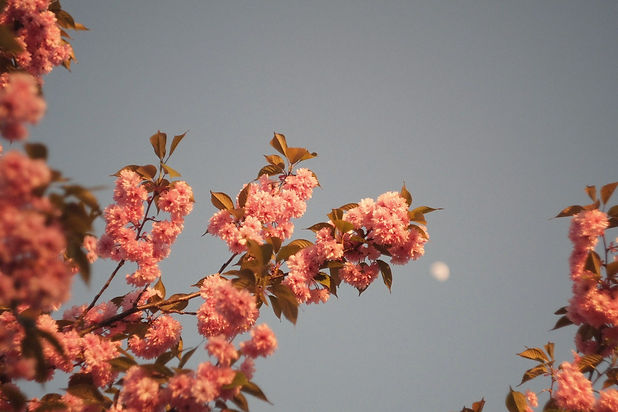
only the ocean

Only the Ocean…
Catastrophe: Pain & Practice
CW: BDSM, Sexual Assault, Violence
Reminder: what it means to you and what it does to your nervous system are two different things, you need care even if you love every moment of an experience & my experience are not instructions
The English poet W. H. Auden says, "My claim to own my body, my world, is my catastrophe."
Claim implies possession and in most of my life, I claim and possess myself and all the pain and joy this brings. What would happen if we claimed less? or saw our claims as illusions. What might we have if we didn't have a catastrophe?
We would talk about change, shift and transformation.
When I was 13, I was violently assaulted and left in the woods. I woke up covered in dirt and dried blood and spiders, panic escalating inside me, and walked home in a world that was never the same.
In the pitch dark years of recovery that followed, I would find a strange comfort in the Vietnam War. I read about the history as well as the experiences of drafted and volunteering young men and women, soldiers and nurses on the front. I felt a kind of kinship with them - abandoned in the jungle with little to prepare them for the violence they would be asked to witness and commit. The soldiers dropped in the jungle, the books about them, the gleaming stainless steel prayers on their Zippo's, the Ace of Spades playing cards; they became tokens of survival for an event that left me only scars. I own a Vietnam War Zippo now, and I kept photos of them in a journal as a teenager.
Reading about the Vietnam War, I learned about a guy named Stockdale. He was a senior naval officer held captive in Hanoi, North Vietnam, for 7.5 years. He was tortured routinely and denied medical attention for the severely damaged leg he suffered during capture, and broken again twice.
Later, when discussing years of torture in an interview, he was asked what kept him alive despite his desperate, seemingly hopeless conditions. He defined, very simply. What we would come to call the Stockdale Paradox.
"This is a very important lesson. You must never confuse faith that you will prevail —which you can never afford to lose — with the discipline to confront the most brutal facts of your current reality, whatever they might be"
What are the most brutal facts of my reality?
To survive trauma as a young person, I had to give up hope that things could be different from what they were, that I could be perfect in a different situation, that I could have avoided my fate with a slightly different morning routine, a different sweater, a different self. I had to deal with exactly what was before me and nothing else. This kind of acceptance is different from hope, and it can't negate it.
You can't read a lot about the Vietnam War and not end up reading about Buddhism. The suppression of Buddhism in South Vietnam led to a deep political crisis and a coup in the 60's that would erode government relations and carve out a path for deeper American involvement that would escalate into war. The self-immolation of Vietnamese Mahayana Buddhist monk Thích Quảg Đứ would become one of the most famous events in modern history. I started reading about Buddhism because of the Buddhist crisis, and started reading about Zazen meditation when I was in university, and I would spend the next several years being really bad at Zen meditation.
I'm still bad at it. This isn't an essay about how being good at mediation saved me. If zazen has taught me anything, it's that nothing can save you. But it also teaches me that if you sit long enough, you learn how to answer the question: what are the most brutal facts of my reality?
No sky, no earth;
Only snow
Ceaselessly falling.
This is, according to my 5 seconds of internet research, the only poem of someone named Hashin that has survived. It's beautiful, a wonderful, almost koan, but also difficult. If it is true of snow, it is true of all things - only pain pounding, only danger waiting, only clouds, only trauma, only rain, only the ocean...
Every brutal or beautiful moment, reality is only snow falling. There is only happening happening, and it is always happening. Life isn't miserable or terrible or wonderful. It's just happening, and that can take the form of misery or anguish or tremendous joy or sunlight in the steam of your pour-over coffee in the morning. Knowing this is freedom. It doesn't make painful things less painful, it can't inoculate you from harm or trauma, and it doesn't absolve you of anything - but that's true about freedom anyway. What it can do is help you survive by showing you the height of your pain lives alongside and concurrently with beauty, joy and wonder.
One thing I find very surprising about Zazen is how similar I find the experience of sitting to that of welcoming and experiencing consensual pain.
Sitting Zazen is a lot like kneeling on all fours for a caning. It is a place I take long moments to become aware of what is happening inside me, what is underneath my thoughts. Zen and pain share a space where noticing and accepting collapse into each other, where everything just is, and all you need to do is exist to see it. With Zen, the struggle is to hold this truth in your mind in stillness, to create stillness in chaos and give it shape and mass, to look into something that resists being known. With pain, the struggle is to move through a flinching instinct and let go of the desire not to experience it, to experience it deeply, to open to pain with stillness. Both of these practices are about sitting still to witness something massive.
These are the two crucial elements of practice: to watch our mind and notice our thoughts, and to experience what is underneath them. But these practice elements only matter as much as our ability to apply them in our lives. We tend to think of practice as some other thing instead of seeing it's just life, like making toast or folding laundry. Snow falling. Meditation shows me that the illusion I like to think of as my life is constant. That to live is to notice.
Our first work is to know ourselves, a lifelong task and difficult because knowing ourselves requires returning over and over to our deepest wounds, the molten cores of our most painful ideas of ourselves. Our wounds are always related to how we think about ourselves. In meditation, we see all our suffering is rooted in our thoughts about ourselves, our claims and attachments to them.
But the more you practice, the more you'll notice that the core ideas of self, while often painful, are seldom true real things in the world; they are ideas, as flawed as we are. I feel this more keenly under a strap or a cane or an open hand - the limits of my body, the boundaries of its relationship to stillness.
The discipline and structure of a sitting practice allow me to sit with the dignity of stillness while being deeply flawed, and the practice of welcoming pain helps me fill my whole body, flaws and all with breath and life, to feel the catastrophe of myself, and welcome it.
Just being in the stillness and the quiet may, like being still under the sharp, relentless snap of a cane, be one of the hardest things I've ever done.